Morgan Stanley's $1.33 Billion Dallas Tower: What It Means for Y'all Street and DFW Land
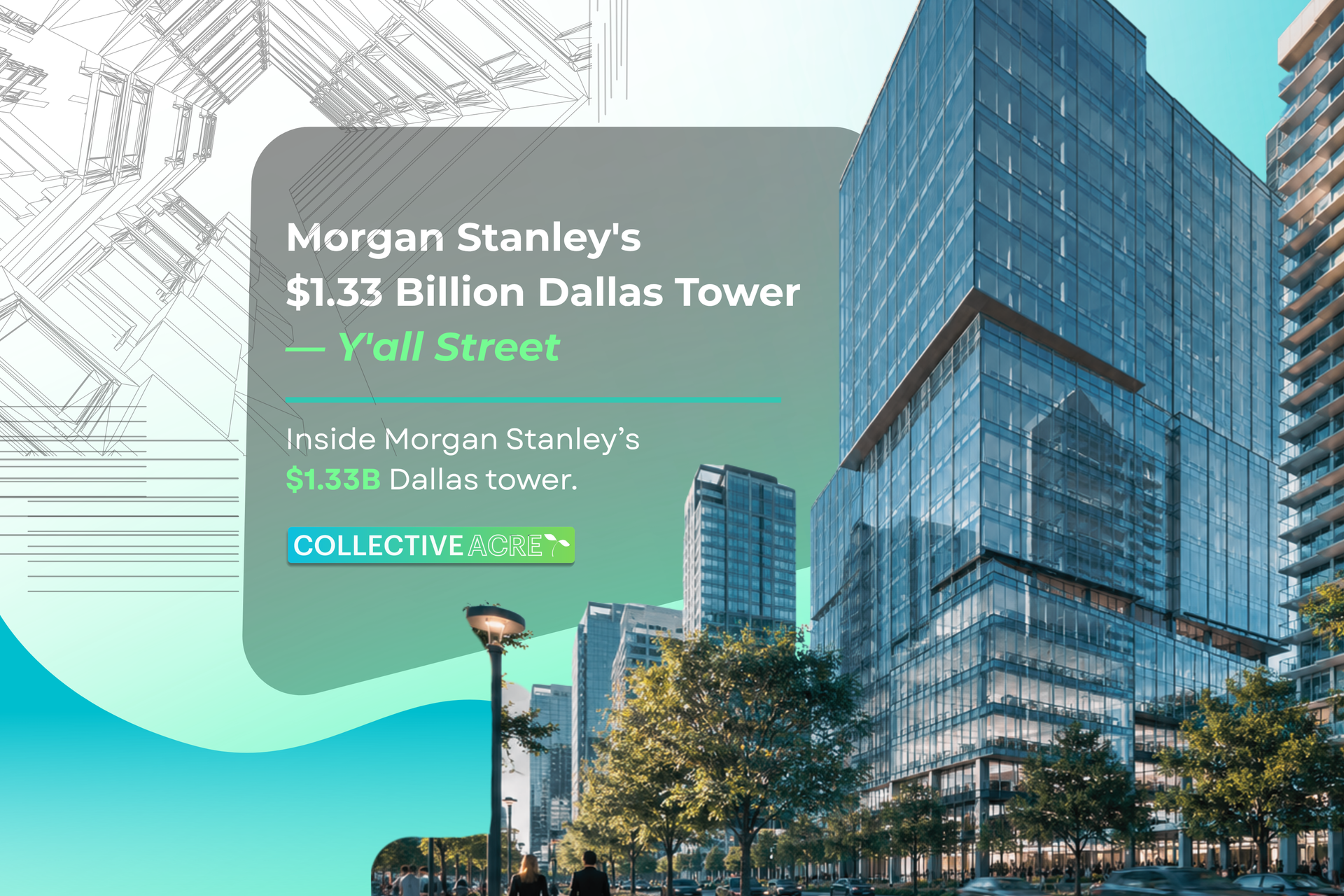
In the spring of 2026, Dallas's emergence as a national financial center moved from narrative to infrastructure. Morgan Stanley — one of the world's largest and most consequential investment banks, with more than 80,000 employees across 42 countries — formally engaged with Dallas to establish a major operational hub in Uptown, anchored by a $1.33 billion tower that would become one of the most significant financial services investments in Texas history.
The project is now underway. Demolition of the former Gold's Gym on McKinney Avenue began in August 2026. Signage permits for Morgan Stanley's interim space at Fountain Place were approved by the Dallas Plan Commission on August 6, 2026. The bank has begun publishing Dallas job listings on LinkedIn. This is no longer a proposal — it is a commitment.
This article examines the structure of the Morgan Stanley deal, the broader Y'all Street context it confirms, and what the project means for land and real estate across the DFW Metroplex.
The Deal: Structure and Scale
The Morgan Stanley Dallas project is a two-phase development. In Phase 1, Morgan Stanley will lease approximately 255,000 square feet at Fountain Place — the landmark downtown Dallas skyscraper at 1445 Ross Avenue — for just over four years, investing nearly $97 million and establishing an initial workforce of 1,500 employees by 2031. This interim arrangement ensures operational continuity while the permanent campus is constructed.
In Phase 2, Morgan Stanley will become the anchor tenant of a newly constructed 708,000-square-foot tower at 2401 McKinney Avenue in Uptown Dallas — at the corner of McKinney Avenue and Fairmount Street. The developer, Trammell Crow Company, will invest approximately $650 million to build the tower. Morgan Stanley will invest approximately $684 million in the permanent facility by 2031, under a 16-year lease. The combined project value is approximately $1.33 billion.
The employment projections, as documented in city council records, are substantial:
- 1,500 jobs at Fountain Place by 2031 (Phase 1)
- 3,800 jobs at the Uptown tower by end of 2035 (Phase 2)
- Up to 4,800 jobs by 2039 — spanning wealth management, compliance, risk management, legal services, technology, and operations
- Average salary requirement: $110,000 — reflecting the high-compensation profile of financial services employment
The site at 2401 McKinney Avenue currently houses a Truluck's restaurant and, until recently, a Gold's Gym — both of which are being cleared to make way for construction. The location places the tower less than one mile from the $500 million Goldman Sachs campus currently under construction nearby, and in close proximity to Bank of America's new Uptown tower.
The Incentive Package: What Dallas Committed
The Dallas City Council voted unanimously on June 25, 2026 to approve the incentive package that secured the Morgan Stanley commitment. The package consists of two primary components:
- $18.5 million in economic development grants — tied to specific hiring benchmarks across both phases of the project
- 90% business personal property tax abatement — applied across the term of the agreement
The incentive structure was described by multiple city officials as one of the largest economic development packages in Dallas history. Mayor Eric L. Johnson characterized the outcome directly: "Morgan Stanley's engagement with Dallas speaks to the strength of our financial services ecosystem, and I look forward to welcoming the firm to Y'all Street."
Dallas Mayor Pro Tem Chad West added: "We have worked hard to make Dallas America's most pro-business city." The unanimous council vote — all 15 members in favor — reflected the rare degree of political alignment around the project's economic significance.
The city estimates the project will generate approximately $65 million in net economic impact over the life of the incentive agreement.
The Competitive Context: Dallas vs. Alpharetta
Throughout the negotiation process, Morgan Stanley publicly disclosed that it was evaluating two sites: Dallas, Texas and Alpharetta, Georgia — an Atlanta suburb where the firm currently employs more than 3,000 people, making it one of Alpharetta's largest employers.
Dallas won. The evidence is now documentary: demolition permits filed, signage approvals recorded, job listings published. While Morgan Stanley has not issued a formal press release confirming the final selection — consistent with the firm's publicly stated policy of declining to comment on real estate decisions — the accumulation of public filings, physical demolition activity, and hiring activity in Dallas establishes the outcome with reasonable certainty.
The competitive dynamic itself is instructive. Dallas was competing against an established Morgan Stanley presence of more than 3,000 employees. The city's financial ecosystem, business environment, tax structure, and the momentum of Y'all Street were sufficient to displace a deeply entrenched competitor location. That outcome reflects a structural shift in Morgan Stanley's assessment of Dallas's long-term viability as a financial hub — not merely a transactional real estate decision.
Y'all Street: The Broader Context
The Morgan Stanley project does not exist in isolation. It is the latest — and among the largest — in a series of major financial institution commitments to Uptown Dallas and the broader DFW financial corridor that has collectively earned the informal designation of Y'all Street.
The roster of commitments currently includes:
- Goldman Sachs: 800,000-square-foot campus under construction near Uptown, expected to house 5,000 employees by 2028
- Bank of America: anchoring a new Uptown Dallas tower
- Scotiabank: establishing a Dallas presence
- NYSE Texas: launched March 31, 2025 — the first securities exchange incorporated in Texas
- Texas Stock Exchange (TXSE): fully live as of July 31, 2026, backed by $275 million from Goldman Sachs, JPMorgan, BlackRock, and Citadel Securities
- Nasdaq Texas: launched March 2026
Together, these commitments represent a structural reorganization of where American financial services firms locate their operational infrastructure. The common threads — Texas's business-friendly regulatory environment, the absence of state personal income tax, a deep and growing talent pool, and significantly lower real estate costs relative to Manhattan — have created conditions that are pulling capital and employment out of New York and into North Texas at a pace that few market observers predicted a decade ago.
What It Means for DFW Land and Real Estate
The Morgan Stanley project's most direct implication for DFW land and real estate is the employment-to-housing demand transmission mechanism. Up to 4,800 high-paying positions — with an average salary requirement of $110,000 — represent a sustained, multi-year influx of high-income households into the Dallas–Fort Worth Metroplex.
This demand does not concentrate exclusively in Uptown Dallas. High-income financial services professionals in Dallas follow a predictable residential pattern: they initially anchor near the urban core, then migrate to suburban communities that offer larger homes, more land, better-rated school districts, and lower price points relative to close-in urban neighborhoods. The suburbs that have historically captured this pattern — Frisco, Plano, McKinney, Prosper, Celina — are the same corridors where land values have appreciated most dramatically over the past decade.
For land investors and developers evaluating DFW, the Morgan Stanley announcement — combined with Goldman Sachs, Bank of America, TXSE, and the broader Y'all Street buildout — provides a multi-year demand signal that reinforces the long-term investment thesis for North Texas residential and mixed-use land. Each institutional commitment reduces the uncertainty around future demand and validates the market for the next wave of capital.
At Collective Acre, we track these macro-level capital movements precisely because of their downstream effects on the land markets we operate in. The financial sector buildout in Uptown Dallas is not a story about a single building. It is a story about the sustained, structural elevation of North Texas as a premium employment destination — and the sustained, structural demand for land and housing that will follow.
Conclusion
Morgan Stanley's $1.33 billion Dallas commitment is one of the most consequential corporate real estate decisions in Texas history. A 708,000-square-foot permanent tower. A 16-year lease. Up to 4,800 high-paying jobs. A unanimous city council vote. And now — demolition underway, signage filed, hiring begun.
Y'all Street is not a marketing slogan. It is the accurate description of a city that now houses three stock exchanges, Goldman Sachs's largest operational campus outside New York, Bank of America's new Uptown presence, and the anchor commitment of one of the world's largest investment banks.
The downstream effects on land, housing, and development across the DFW Metroplex will be measured in years, not quarters. For investors positioned ahead of that curve, the signal is already clear.