Venus, Texas: The DFW Suburb Growing at Over 10% Per Year
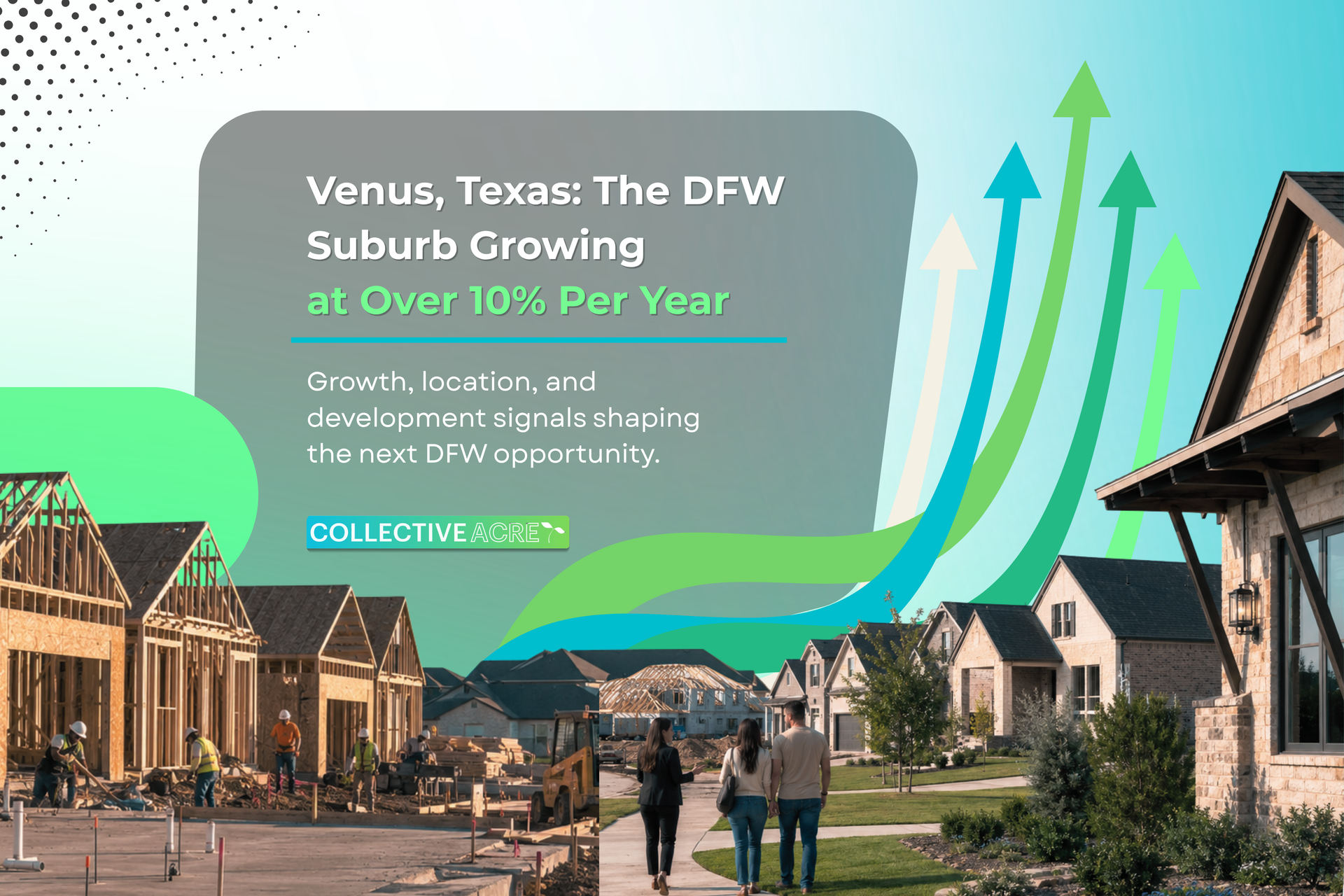
In the landscape of Dallas–Fort Worth suburban growth, certain cities have dominated the conversation for years. Frisco. Celina. Prosper. McKinney. These communities became synonymous with rapid expansion, rising home values, and the infrastructure investments that precede sustained growth. What the broader market discussion has not yet caught up to is that a new city is displaying many of those same early signals — and doing so at a growth rate that rivals any of them at a comparable stage of development.
That city is Venus, Texas.
Located in Johnson County approximately 30 miles south of Arlington, Venus is growing at a rate of 10.19% annually — a pace that reflects not a temporary anomaly but a sustained and structurally supported expansion driven by affordability, accessibility, and institutional builder confidence. This article examines the data behind that growth and the investment signals it generates for the DFW land market.
The Growth Numbers: What the Data Shows
The 2026 population of Venus, Texas is 9,774, according to data published by World Population Review in June 2026. That figure represents a 113.03% increase since the 2020 census, which recorded a population of 4,588 residents. In 2000, Venus had a population of 4,361. In the 26 years that followed, the city has grown by more than 124%.
Several additional demographic indicators reinforce the growth narrative:
- Annual growth rate: 10.19% — one of the highest among small Texas cities of comparable size
- Median household income: $106,023 — approximately 39% above the Texas state median of $76,292
- Median age: 30.8 years — a young demographic profile consistent with first-time homebuyer and young family demand
- Location: Johnson and Ellis Counties, with US Highway 67 as the primary arterial corridor
These figures paint a picture of a city that is not merely growing — it is attracting a demographically desirable population with the financial capacity to sustain homeownership and drive continued commercial development.
Geographic Position: The DFW Growth Corridor Advantage
Venus's geographic positioning is central to understanding its growth trajectory. The city sits between I-35W to the west and I-35E to the east, accessed via US Highway 67, placing it within practical commuting distance of the entire southern DFW employment corridor. Downtown Dallas and Fort Worth are each approximately 31 miles from Venus — a commute that, while not trivial, is comparable to the distances accepted by residents of Celina and Prosper when those cities were at similar early-growth stages.
More significantly for future growth, State Highway 360 is set to expand southward in close proximity to Venus, according to the City of Venus Economic Development page. Highway 360 has been instrumental in unlocking development along its corridor in cities such as Grand Prairie and Mansfield. Its southward extension toward Venus represents precisely the kind of infrastructure investment that historically precedes land value appreciation in the surrounding market.
Builder Activity: Institutional Confidence in the Market
Perhaps the most compelling indicator of a market's near-term growth trajectory is the behavior of national homebuilders — organizations that deploy substantial capital only after rigorous market analysis and demand validation. In Venus, that institutional signal is unambiguous.
According to the City of Venus Planning and Zoning Department, the following development projects are currently active or approved:
- Patriot Estates Phase 8 & 9 — LGI Homes: approximately 668 homes
- Stallion Ranch — LGI Homes: approximately 280 homes
- Braham Ranch Phase 1 & 2: approximately 386 homes
- Heritage Hills Phase 1 & 2 (duplex/fourplex): approximately 300 units
- Bankston: approximately 106 homes
- Ridgeview Addition — Lillian Homes: 54 homes
These six active projects represent approximately 1,794 homes and units currently in the Venus development pipeline. LGI Homes alone — a publicly traded national builder (NYSE: LGIH) headquartered in The Woodlands, Texas, operating in more than 20 states — is committing to nearly 950 homes across two separate communities in the same city. LGI's Patriot Estates, located off Highway 67 near Highway 287 and I-35, offers new homes starting from $284,900 — priced more than 10% below the area's average of $487,900, per data published by Jome.
Patriot Estates includes a community pool, clubhouse, walking trails, children's playground, basketball court, and picnic areas — amenities that reflect LGI's assessment that Venus residents expect and will support the full suburban lifestyle proposition, not simply a minimal entry-level product.
The Affordability Proposition
Venus occupies a distinctive position in the DFW affordability landscape. In a metropolitan area where median home prices in established suburbs regularly exceed $500,000, the availability of new construction homes starting below $300,000 from a nationally recognized builder represents a material market opportunity.
For first-time homebuyers, young families, and value-oriented purchasers who have been priced out of closer-in DFW communities, Venus offers a viable path to new construction homeownership with access to the employment corridors and amenities of the broader Metroplex. This affordability-driven demand has historically been one of the most durable drivers of suburban growth in Texas — it is the same dynamic that powered the early growth of Allen, Wylie, and, more recently, Celina.
The Investment Thesis: Early-Stage Indicators in Context
At Collective Acre, our research methodology requires us to assess markets against a consistent framework before drawing conclusions about their investment merit. Venus presents a compelling profile across multiple dimensions of that framework.
Population velocity — a 10.19% annual growth rate — is exceptional for a city at this population level. Infrastructure signals — the planned southward expansion of State Highway 360 — are concrete and documented. Builder confidence — nearly 1,800 homes committed by national and regional builders — is institutional-grade validation of market demand. And the affordability proposition — new homes from $284,900 in a market where DFW area averages exceed $487,900 — ensures a sustained buyer pool that will drive absorption of the current pipeline and support demand for additional development.
The pattern is familiar to those who have studied the growth trajectories of DFW's most successful suburban markets. The cities that generated the strongest returns for land investors were not identified at the peak of their growth cycles. They were identified at precisely the stage Venus occupies today: a period of early-stage institutional commitment, infrastructure investment, and demographic influx, before broader market recognition drives valuations to reflect the full growth story.
Conclusion
Venus, Texas is not a speculative story. It is a city with verified population growth exceeding 10% annually, a median household income well above state averages, six active development projects from credible national and regional builders, a strategic geographic position in the DFW growth corridor, and documented infrastructure investment in its direction.
The question for investors and developers evaluating North Texas land markets is not whether Venus will grow — the data indicates it already is. The question is whether to act on that recognition before the market broadly prices in what the underlying indicators already suggest.
At Collective Acre, we track early-stage growth markets across DFW with the discipline of institutional research and the perspective of active developers. Venus represents one of the most compelling early-stage profiles we have observed in the current cycle.