Venus, TX vs. Celina, TX: What Early Looks Like Before the Boom
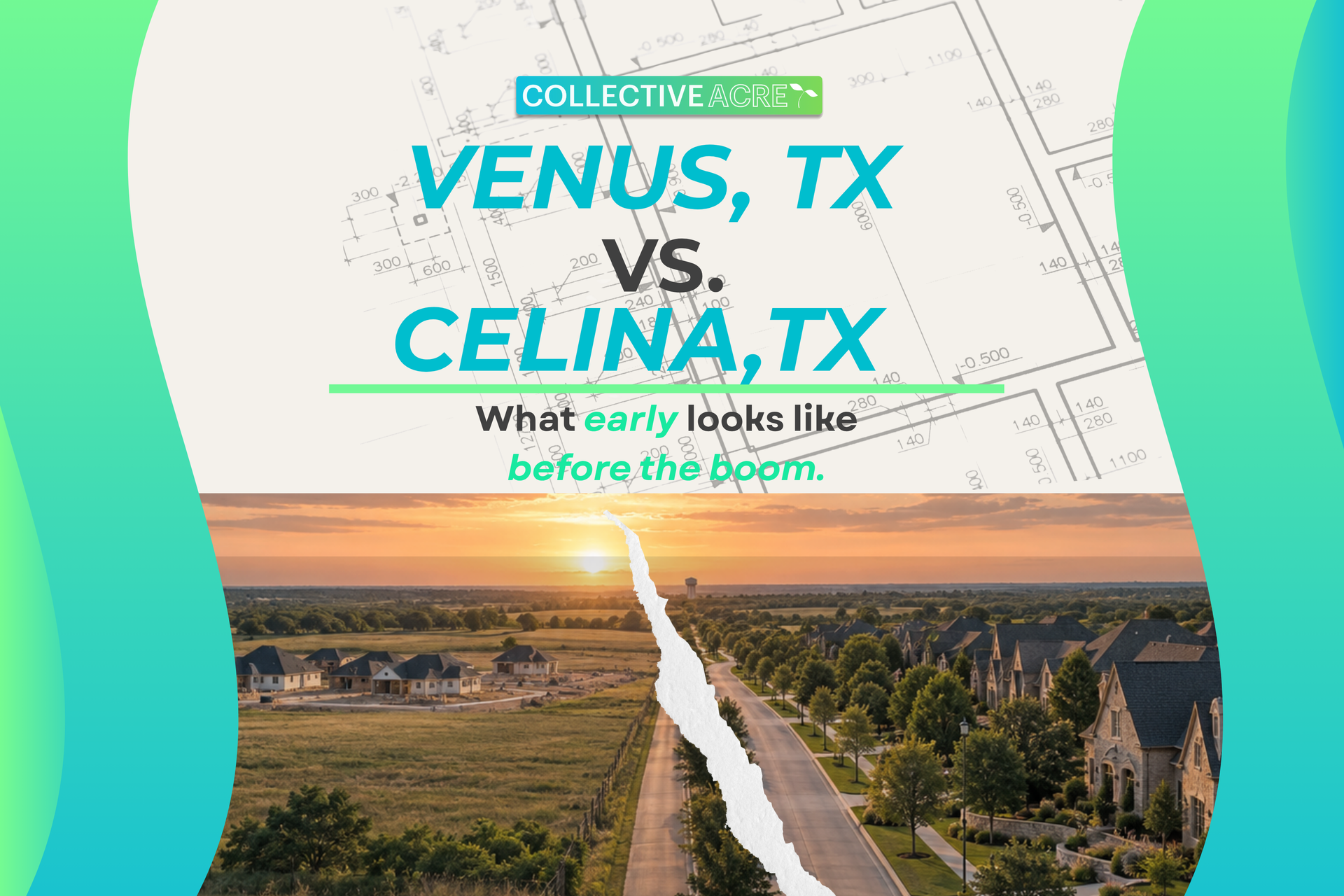
In the history of DFW's suburban growth cycle, no comparison is more instructive for a land investor than the one between a city that has already boomed and a city that is just beginning to show the same early signals. Celina, Texas is the former. Venus, Texas is the latter.
This is not a prediction. It is a pattern recognition exercise — one grounded in verified population data, documented infrastructure history, and observable builder behavior. The purpose is not to claim that Venus will replicate Celina's specific growth trajectory. It is to identify what the early stage of a growth story looks like in the DFW context, and to evaluate how closely Venus's current profile matches that description.
The answer, as the data shows, is closely.
Celina: The Full Arc — Before, During, and After
To understand what Venus may be in the early stages of becoming, it is necessary to understand what Celina actually looked like before it became the story it is today.
In 2010, Celina was a quiet farming community of 6,353 residents in Collin County, approximately 40 miles north of downtown Dallas. Its downtown consisted of historic buildings — a railroad hotel, a century-old bank facade — that had not changed materially in decades. It had modest highway access via Texas State Highway 289, a handful of small businesses, and no national homebuilder presence of any scale.
The inflection point came in 2013, when Republic Property Group officially opened Light Farms — a 908-acre master-planned community on Celina's south side, positioned at the end of the Dallas North Tollway and priced from the low $300s. Republic had acquired the land in 2006, recognizing the trajectory of the Tollway extension before it was widely appreciated. By September 2016, builders had already sold nearly 700 homes in the first phases of Light Farms' 3,200-home buildout, and the Dallas Morning News was calling Celina the next DFW boomtown. New home prices at that time started at approximately $250,000.
The infrastructure signal that preceded and sustained all of this was the Dallas North Tollway extension — the planned northward extension of the DNT through Prosper and into Celina that transformed the corridor's accessibility to Dallas employment centers and positioned it as a viable alternative to closer-in, more expensive suburbs.
What happened next is documented in the census records:
- 2010 census: 6,353 residents
- 2020 census: 18,033 residents — a 178.86% increase over a single decade
- 2024 estimate: 51,661 residents — an 8.1x growth from 2010 in 14 years
- 2026 projection: 72,848 residents — growing at 13.07% annually, up 303.97% since the 2020 census
- Light Farms median sale price today: $724,000 — up 7% year-over-year
- Median household income: $170,894 — among the highest in Texas
The investors and developers who acted on the early signals — population under 10,000, national builder entering the market, Tollway extension on the way, home prices still accessible — captured the returns that Celina's growth produced. Those who waited until the story was obvious found a fully priced market.
Venus, TX in 2026: The Early Signals Profile
With the Celina arc documented, the question is whether Venus, Texas in 2026 is displaying a recognizable version of the same early signals. The comparison is not geographic — Venus is in Johnson and Ellis Counties to the south of DFW, while Celina is in Collin County to the north. The comparison is structural: what does the data profile of a city at the beginning of its growth cycle look like, and does Venus match it?
The answer across four key dimensions is affirmative.
Signal 1: Population Under 10,000, Growing at Double Digits
Celina in 2010 had 6,353 residents and was growing at approximately 4% annually — modest by DFW standards, but with a trajectory that was building. Venus in 2026 has 9,774 residents and is growing at 10.19% annually — a significantly faster pace at a comparable population level.
The growth rate differential is instructive. Celina's acceleration came after the infrastructure signal was confirmed and institutional builders committed. Venus is already growing at over 10% annually before the proposed SH-360 extension is confirmed and before the full builder pipeline has been absorbed. The baseline growth is stronger, and the potential infrastructure catalyst has not yet been realized.
Signal 2: National Builder Institutional Commitment
The single most reliable indicator that a market has been validated by institutional analysis is the entry of a publicly traded national homebuilder with a multi-phase commitment. In Celina's case, that signal came with Light Farms in 2013 — and within three years, the market had absorbed nearly 700 homes in the first phases alone.
In Venus, that signal is already present. LGI Homes (NYSE: LGIH) — a publicly traded national homebuilder headquartered in The Woodlands, Texas — is committing to approximately 948 homes across two separate communities: Patriot Estates (approximately 668 homes across Phases 8 and 9) and Stallion Ranch (approximately 280 homes). New homes at Patriot Estates are priced from $284,900, according to Jome — a figure that is more than 10% below the DFW area average of $487,900.
LGI does not establish two separate multi-phase communities in the same city without completing the market analysis to support that decision. The company's dual presence in Venus is institutional validation that the demand profile supports sustained absorption at scale.
Five additional active projects — Braham Ranch (~386 homes), Heritage Hills (~300 duplex and fourplex units), Bankston (~106 homes), and Ridgeview Addition (54 homes) — bring the total Venus pipeline to approximately 1,794 homes and units, according to the City of Venus Planning and Zoning Department.
Signal 3: Infrastructure Investment Heading Its Way
Celina's defining infrastructure catalyst was the Dallas North Tollway extension — a planned improvement that positioned the city within a direct commute corridor to Dallas employment centers and anchored the economic rationale for large-scale residential development.
Venus's analogous signal is the proposed extension of State Highway 360. The North Texas Tollway Authority is currently conducting an environmental study for an approximately 8-mile extension of the 360 Tollway southward from US 287 to US 67 — with Venus in the study area. Two public meetings have already been held: the first at Venus Middle School in October 2024, and the second at Mansfield High School in April 2026, according to NTTA's official project page. Alternative alignments have been presented and public comments collected.
The extension is in the environmental study phase — no preferred alignment has been selected and no construction timeline has been confirmed. This is precisely the stage at which Celina's infrastructure signal existed in the early 2010s: proposed, advancing, and not yet priced into the surrounding land market.
Signal 4: Entry-Level Pricing Still Accessible
Celina in 2013 and 2016 offered new construction from approximately $250,000 — significantly below competing DFW suburbs and accessible to a broad range of first-time and move-up buyers. That affordability proposition was a primary driver of the absorption velocity that validated the market for successive waves of development.
Venus in 2026 offers new construction from $284,900 — more than 10% below the DFW area average of $487,900. The affordability gap that made Celina compelling in its early growth phase is present in Venus today. And critically, it is present in a DFW market that has meaningfully higher average prices than it did a decade ago — which means the absolute affordability advantage Venus represents is even more pronounced relative to the broader market than Celina's was in its comparable early phase.
The Key Difference: Stage, Not Destination
The most important clarification in this comparison is also the most important investment insight. Venus is not Celina. The two cities have different geographic positions, different infrastructure timelines, and different surrounding market contexts. Venus will not necessarily replicate Celina's specific growth trajectory.
What Venus shares with Celina circa 2010–2013 is its stage: a city with a documented growth rate, institutional builder validation, a proposed infrastructure improvement not yet confirmed, and entry-level pricing that is still accessible to a broad demand base.
In Celina, that stage preceded a decade of transformational growth that produced 8.1x population expansion in 14 years and home prices at Light Farms that now average $724,000. The investors who recognized the early stage captured that appreciation. Those who waited until Celina was widely recognized as a growth market did not.
The parallel question for Venus is straightforward: is the city currently in an early stage that resembles, structurally, what Celina looked like before its growth was broadly recognized? The data — population velocity, builder commitment, infrastructure trajectory, and affordability positioning — suggests the answer is yes.
Collective Acre's Position
At Collective Acre, we do not invest in headlines. We invest in early-stage signals — population velocity, infrastructure direction, institutional builder commitment, and affordability dynamics — before those signals are broadly priced into the land market.
We own 100 acres in Venus, Texas. We acquired that position because the structural profile of the market matched our criteria for early-stage investment: a city growing at double-digit rates, national builders committing at scale, infrastructure improvement proposed and advancing, and land still available at prices that reflect the early stage of the story rather than the mature one.
The Celina comparison is not a marketing narrative. It is a framework for evaluating whether the signals present in a city's early growth phase are structurally similar to those that preceded a documented boom. In Venus's case, they are. What happens next will be determined by factors that are not yet fully known — the SH-360 extension timeline, the pace of builder absorption, and the broader DFW demand environment chief among them.
What is known is that the window in which early-stage land in Venus is priced at early-stage values is finite. It was finite in Celina, too. Investors who recognized that in 2013 acted accordingly.