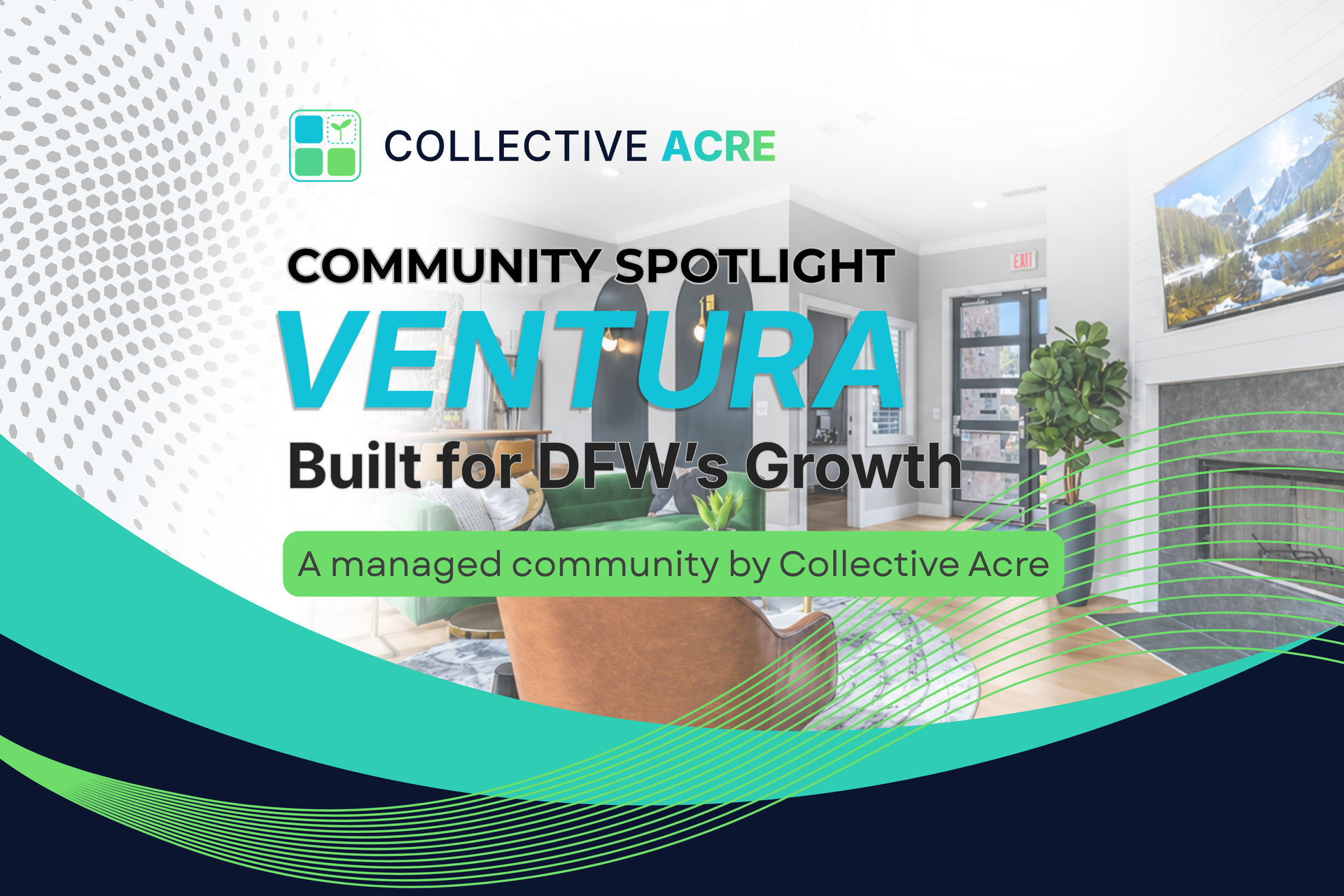
Ventura: Built for DFW's Growth
The Dallas–Fort Worth Metroplex is the fastest-growing major metropolitan area in the United States. At approximately 8.4 million residents and adding between 100,000 and 130,000 people annually, DFW is not merely growing — it is absorbing a city the size of a mid-sized American community every single year. More than 25,000 new households are projected to form across the metroplex in 2026 alone.
That growth is not slowing in any structural sense. Corporate relocations continue. The Texas economy — spanning energy, technology, finance, and healthcare — keeps generating jobs at a pace that produces organic housing demand independent of migration. TxDOT's long-range infrastructure plan totals nearly $195 billion statewide, with more than $50 billion tied directly to North Texas projects. The growth machine is being actively fueled by both public and private capital at a scale that few metropolitan areas in the country can match.
What that growth produces — in addition to opportunity — is pressure. Pressure on housing supply. Pressure on commute corridors. Pressure on the quality of day-to-day community life as rapid growth outpaces the development of thoughtfully managed shared environments. And pressure on the question that every person relocating to or within DFW must answer: where do I live, and who manages it?
Ventura, developed and managed by Collective Acre, is the answer to that question we have built for DFW's growth cycle. This article explains what Ventura is, what it is designed to deliver, and why the case for a well-managed community in North Texas has never been stronger.
What DFW's Growth Actually Demands in 2026
Understanding Ventura begins with understanding the population it is designed to serve — and the housing market dynamics that have shaped its demand.
DFW's growth is not uniform. As documented by maligariani.com in July 2026, the market is bifurcating: demand for affordable housing remains structurally strong, while oversupplied price points face pressure. The most recent data from scribnerdfw.com, published August 18, 2026, documents a meaningful shift in DFW's rental market: renters are now absorbing apartments faster than new units are being delivered, marking an end to the recent oversupply period. Stabilized assets are seeing positive rent growth — Uptown Dallas above 4%, intown Fort Worth approaching 3%.
One of the fastest-growing trends across North Texas in 2026 is build-to-rent development. Strong population growth combined with persistent affordability constraints has created sustained demand for professionally managed rental housing — where residents get the benefits of a stable community without the capital commitment of homeownership. As Keck Capital documented in June 2026, this shift is attracting builders, developers, and institutional capital from across the country.
The residents driving this demand share a specific profile. They are mobile. They value flexibility. They are choosing North Texas because of its job market, its cost of living relative to coastal alternatives, and the quality of life it offers. What they are looking for in a managed community — and what the 2026 Resident Experience Management Report by Zego confirms they are not finding consistently — is a community where management is genuinely responsive, where shared spaces are well-maintained, where safety and security are baseline expectations, and where the environment supports real human connection with neighbors.
That is what Ventura is built to deliver.
The Ventura Approach: Management as a Design Principle
At Collective Acre, we do not treat management as an afterthought to development. We treat it as a design principle — the framework within which every decision about Ventura's operations, physical environment, and resident experience is made.
The 2026 Resident Experience Management Report documents that average retention rates in managed communities have dropped to 57%, down from 60% in 2024 — and attributes this decline not to amenities or pricing, but to a widening perception gap between what operators believe they are delivering and what residents actually experience day to day. The communities that are losing residents are not, in most cases, the ones with inadequate amenities. They are the ones with inadequate management.
Ventura's management philosophy is built around five principles that the research consistently identifies as the true determinants of resident satisfaction and retention:
1. Responsiveness — The Highest-Ranked Priority
The single most consistent finding in resident satisfaction research is that staff friendliness and responsiveness outranks every physical amenity in determining whether a resident chooses to stay. A community with an excellent pool and a slow or indifferent management team will lose residents that a community with a modest pool and genuinely responsive management will keep. At Ventura, responsiveness is an operational standard — not a policy, not an aspiration, and not something that happens only when the situation is easy.
2. Maintained Shared Spaces — A Signal of Respect
The condition of a community's shared spaces communicates to residents how management views them. Consistently maintained spaces signal that standards are being upheld and that the management team is engaged — not merely reacting when conditions deteriorate. At Ventura, maintenance standards are proactive and systematic. Residents should never be the first to notice a problem that management should have caught.
3. Safety and Security — A Non-Negotiable Baseline
Safety and security are not premium features at Ventura. They are baseline operational requirements. Controlled access, adequate lighting, and active monitoring of community conditions are the foundation, not the ceiling. Residents who feel genuinely secure in their community are significantly more likely to stay, to recommend the community to others, and to engage meaningfully with the people around them.
4. Transparent and Proactive Communication
Residents who feel informed about what is happening in their community — what projects are underway, what changes are coming, what management is working on — report materially higher satisfaction than those who feel out of the loop. At Ventura, communication is structured around a simple principle: residents should never be surprised by something management already knew. Proactive communication is not a courtesy; it is an operational discipline.
5. Genuine Community — The Outcome That Retains
The 2026 Homeowner Satisfaction Survey, conducted by the Foundation for Community Association Research in partnership with Zogby Analytics, confirms what experienced community managers already know: residents who feel that they belong to something — who have positive relationships with neighbors, who feel pride in where they live — are the most durable retention asset a managed community can develop. Amenities can be replicated. A genuine sense of community cannot. At Ventura, creating the conditions for that community is a management responsibility — not a programming calendar.
Why DFW's Growth Makes Ventura's Thesis Stronger, Not Weaker
There is a counterintuitive dimension to DFW's growth dynamic that is worth naming directly. The same conditions that make North Texas an attractive place to live — rapid growth, new development, expanding suburban corridors — also make the managed community that gets management right more valuable, not less.
When a market is growing rapidly, the supply of new housing units increases. What does not automatically increase is the supply of well-managed community environments. New construction delivers units. It does not automatically deliver the management culture, the operational discipline, and the genuine community investment that turn a collection of units into a place residents are proud to call home.
DFW's growth is adding population, households, and housing inventory simultaneously. The communities that will perform best — that will achieve the highest retention, the strongest referral rates, and the most durable competitive position — are the ones that distinguish themselves not through physical features, which can be replicated, but through the quality of their management, which cannot be acquired off a shelf.
That is the case for Ventura in DFW's 2026 growth environment. The market is large, it is growing, and it is producing residents who are actively looking for a managed community experience that delivers on its promises. We built Ventura to be that community.
Collective Acre's Commitment
Ventura represents Collective Acre's management thesis made concrete. We entered this market as land investors and developers with a specific conviction: that in a fast-growing metro like DFW, the gap between average-managed and well-managed communities is wide, and that gap represents both a problem for residents and an opportunity for operators who take management seriously.
Our investment in Ventura is an investment in the proposition that DFW residents — the ones choosing North Texas for its opportunity, its affordability, and its quality of life — deserve a community that is operated with the same discipline and attention that went into developing it. A community that is responsive, maintained, secure, communicative, and genuinely alive as a social environment.
DFW is growing. The question is not whether there will be demand for managed communities in North Texas. The question is which managed communities will be worth living in. Ventura is our answer.