Stormwater: The Invisible Battle of Land Development in Texas
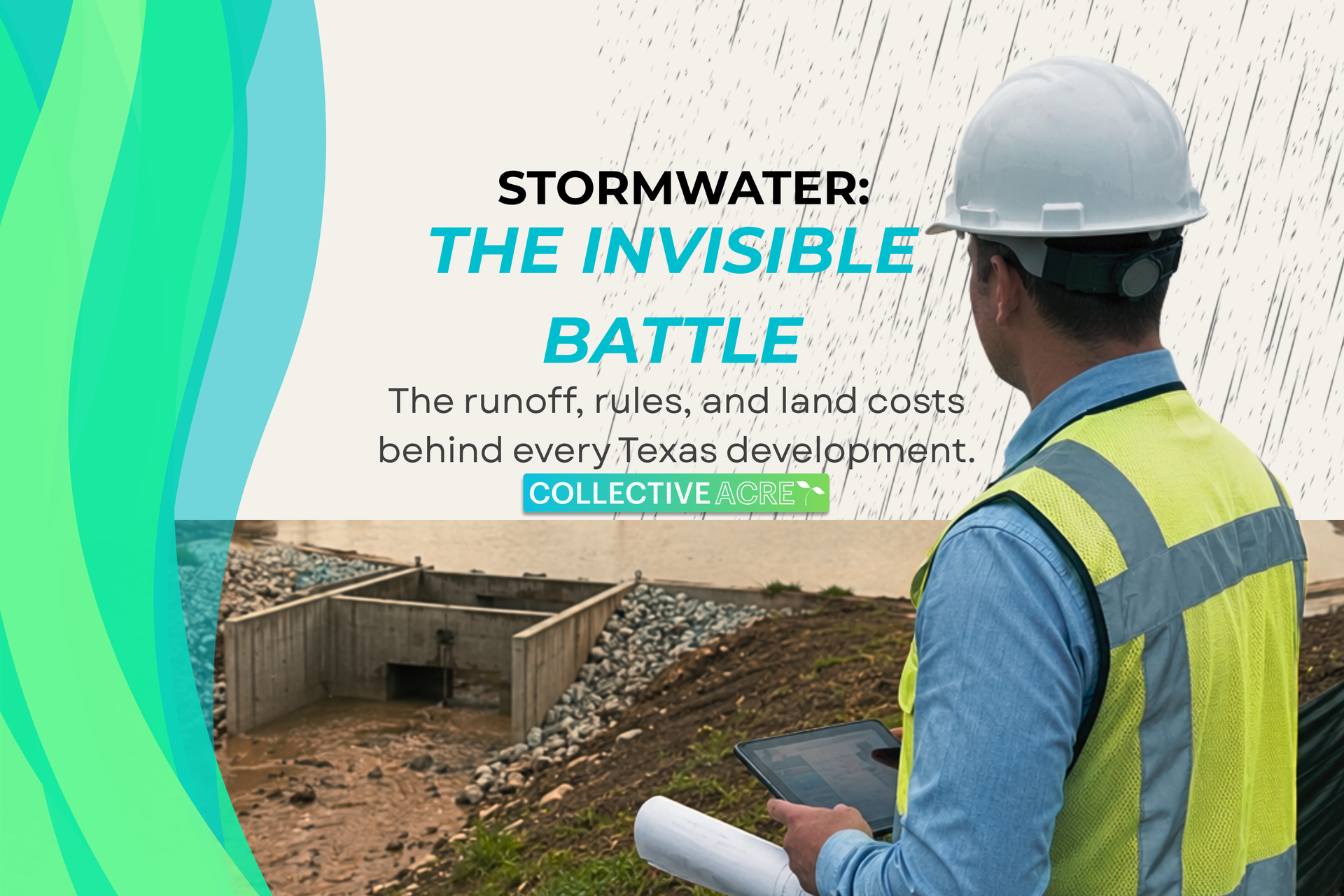
Every development project in Texas is, at its core, a negotiation with water. Rain falls on a site. It runs off. And the question — answered differently by every municipality, every watershed, and every site-specific set of conditions — is where that water goes next and at what rate.
When that question is answered well, by an experienced civil engineer working within a regulatory framework that has been properly navigated, the stormwater infrastructure on a finished development is invisible. Detention basins become green space or sports fields between storm events. Underground systems disappear beneath pavement. The homeowner or commercial tenant who occupies the finished product has no awareness of the engineering, regulatory work, and capital expenditure that shaped the drainage of the site they are standing on.
When that question is answered poorly — or not answered at all before a project breaks ground — the consequences are visible, expensive, and sometimes project-ending. Flooded adjacent properties. Stop-work orders from the Texas Commission on Environmental Quality. Re-engineering of grading and drainage systems after construction has already begun. The discovery, too late, that a proposed detention basin consumes a portion of the developable site large enough to impair the project's financial model.
This article examines stormwater management in Texas land development — what the regulatory framework requires, what it costs, and why experienced developers treat it as one of the earliest and most consequential technical questions in the development process.
The Texas Regulatory Framework: TCEQ and the Construction General Permit
Stormwater regulation in Texas land development is administered by the Texas Commission on Environmental Quality (TCEQ) under the Texas Pollutant Discharge Elimination System (TPDES) program — the state-run equivalent of the federal National Pollutant Discharge Elimination System (NPDES) authorized under the Clean Water Act. When rain runs off a construction site and carries sediment, debris, or pollutants into a creek, storm drain, or other water body, that runoff constitutes a discharge under the Clean Water Act — and it requires a permit.
The primary instrument for construction-related stormwater permitting in Texas is the Construction General Permit (CGP), permit number TXR150000, issued by TCEQ. The permit covers construction activities that disturb one acre or more of land, or any smaller site that is part of a larger common plan of development that will ultimately disturb one acre or more. The current CGP expires on March 5, 2028; TCEQ held a stakeholder renewal meeting on June 9, 2026 to discuss preliminary proposed changes to the next permit cycle.
The practical requirements of the CGP for Texas developers and contractors are as follows:
● For projects disturbing 5 acres or more: a full Stormwater Pollution Prevention Plan (SWPPP) and a Notice of Intent (NOI) filed through TCEQ's online STEERs system, at least 48 hours before earth disturbance begins. The NOI filing fee is $225. Beginning earth disturbance before the NOI is filed constitutes a day-one violation.
● For projects disturbing 1 to 5 acres: a full SWPPP and a Small Construction Site Notice filed with TCEQ. No NOI is required for this size category, but the SWPPP obligations are equivalent.
● Inspection requirements: TCEQ requires site inspections within 24 hours of any storm event that deposits 0.5 inches of rain or more. Inspection logs must be accurate, current, and reflect actual site conditions — not generic documentation.
The SWPPP itself — the Stormwater Pollution Prevention Plan — is the written management plan that documents how the construction site will control erosion, manage sediment, and prevent stormwater pollution during the construction period. It must identify the specific Best Management Practices (BMPs) in use on the site, document their installation and condition through regular inspections, and be updated as site conditions change across the construction timeline.
TCEQ's 2026 enforcement priorities represent a meaningful shift from prior years. According to the May 2026 TCEQ compliance guide published by Eco Permit Pros, inspectors are now focusing on accuracy, documentation, and real-world BMP performance — not simply whether a SWPPP document exists. A SWPPP that specifies silt fences but shows wattles installed on the actual site is a violation, even if the wattles are more effective. Bare soil leading to sediment runoff remains the number one cause of enforcement actions. And an increasing number of DFW municipalities are adding local stormwater requirements below the one-acre threshold for sites near sensitive watersheds.
Detention and Retention: The Capital Cost Dimension
The TCEQ permitting and SWPPP requirements described above govern construction-phase stormwater management — the temporary controls that prevent sediment runoff during the period when a site is disturbed and bare. Equally significant, and in many cases more capital-intensive, is the permanent stormwater infrastructure required to manage post-development runoff for the life of the project.
In Texas, there is no statewide mandate governing permanent stormwater detention requirements. The requirement is a local municipal determination, and the standards vary meaningfully by jurisdiction. DFW municipalities typically require that post-development peak discharge rates not exceed pre-development levels — measured against a specified design storm, most commonly the 100-year storm event. The practical consequence of this requirement is that a developed site must demonstrate, through engineering analysis, that its improved condition does not increase the rate of stormwater runoff reaching downstream properties or waterways relative to the site's pre-development condition.
The engineering solution to that requirement is, in most Texas development contexts, a detention or retention facility — a basin designed to capture stormwater runoff from the developed site, hold it, and release it at a controlled rate that does not exceed pre-development flow levels.
Detention basins — the most common form in DFW suburban developments — are dry basins that capture stormwater during storm events and release it gradually through an outlet structure. Between storms, they are empty and can function as parks, sports fields, or open green space. Retention ponds maintain a permanent pool of water and are more common in contexts where water quality treatment or aesthetic value justifies the ongoing maintenance obligation.
The cost of permanent stormwater facilities in Texas varies significantly based on site size, required storage volume, soil conditions, and the specific standards of the governing municipality:
● Excavation costs for detention basins in DFW: $8 to $12 per cubic yard for standard conditions; $20 or more per cubic yard where rock removal or unsuitable soil requiring off-site disposal is encountered, according to CC Engineering's July 2026 Argyle, TX detention pond cost guide.
● A 5-acre commercial site in DFW typically requires 0.5 to 1.0 acre-feet of detention storage — yielding earthwork costs of $10,000 to $18,000 for excavation alone in standard soil conditions. Outlet structure, grading, vegetation, and engineering add to that base.
● Wet retention ponds cost $0.50 to $1.00 per cubic foot (2026 pricing). Annual maintenance for a retention pond runs $2,500 to $7,350 per acre of pond surface, according to Aqua Rain Water's April 2026 cost guide. Dredging, required roughly every five years, costs $20 to $60 per cubic yard plus disposal.
● Land cost is the variable most commonly excluded from detention cost estimates. A surface detention facility sized for the 100-year storm can consume 4,000 square feet or more of a site. At $30 to $80 per square foot in suburban DFW, that represents $120,000 to $320,000 in land cost that is not available for developable use.
The land cost dimension of detention is where the financial impact is most acutely felt in high-value suburban markets. Every square foot dedicated to a detention basin is a square foot that cannot be sold as a lot, leased as commercial space, or developed as rentable residential unit. The size of the required detention facility is therefore a direct function of the project's financial returns — and in dense suburban markets where land values are high, even modest differences in required detention volume can have material effects on the project pro forma.
Houston's 2026 Rule Change: A Signal for DFW
Houston's Infrastructure Design Manual (IDM) Chapter 9, governing stormwater detention requirements, was revised effective June 1, 2026. The most significant change: a new flat detention rate of 0.8 acre-feet per acre for all new development and redevelopment projects under 20 acres, replacing a more complex formula. The revision also introduced new redevelopment credits for existing impervious cover, simplifying calculations for infill projects.
The Houston rule change is relevant for DFW developers not because DFW follows Houston's standards, but because it illustrates the direction of municipal stormwater policy in Texas: requirements are tightening, not loosening. Each major revision to local stormwater ordinances in Texas markets has, historically, increased the detention requirement rather than reduced it. American Paving TX notes that Houston's detention rates have nearly quadrupled since 2021.
DFW municipalities maintain their own individual standards. Weatherford, for example, requires peak discharge matching for the 2-, 10-, and 100-year storm events. The specific design storm and required storage volume vary by city — which is why pre-development engagement with the local public works or engineering department is a non-negotiable step in any DFW project's stormwater planning process.
Stormwater as a Site Selection Variable
For land investors evaluating parcels in DFW and across Texas, stormwater carries implications that extend beyond the development phase. The stormwater characteristics of a site — its existing drainage patterns, its proximity to floodplains, its soil permeability, and the stormwater standards of its governing municipality — are material factors in the site selection decision, not variables to be addressed after acquisition.
The floodplain dimension is the most binary: a parcel that contains a FEMA-designated Special Flood Hazard Area (SFHA) has a constrained buildable envelope, faces mandatory flood insurance requirements for any structures within the SFHA, and may require substantial engineering to demonstrate no adverse impact on flood elevations before any development activity can proceed. In some configurations, a floodplain that bisects a parcel can reduce the effective developable acreage to a fraction of the total area — a fact that a land value calculation based on total acreage will systematically overstate.
Beyond the floodplain, the stormwater characteristics of a site affect the detention requirement — and therefore the land cost — of a project. A site with existing tree cover, native vegetation, and permeable soils produces less runoff per acre of disturbance than a site that is already partially impervious. A site adjacent to existing regional detention infrastructure may benefit from reduced on-site detention obligations. A site that drains naturally into a large downstream conveyance system may have more flexibility in detention design than one that drains to a constrained downstream channel with limited capacity.
These site-specific variables are not visible in an aerial photograph or a zoning map. They require a civil engineer's analysis, a FEMA map review, and — increasingly — a pre-development meeting with the local municipality's drainage and engineering staff. Developers and investors who complete that analysis before acquisition are making decisions with full information. Those who complete it after are managing risk they did not price.
Conclusion
Stormwater management is the invisible battle in Texas land development because its infrastructure — when executed correctly — disappears. The detention basin becomes a park. The underground system runs beneath the parking lot. The SWPPP that governed eighteen months of construction-phase compliance is filed in a binder that no future occupant will ever open.
But the battle itself is real, the regulatory stakes are significant, and the capital costs — excavation, outlet structures, land consumption, annual maintenance — are substantial enough to reshape a project's financial model if they are not anticipated and planned for in advance.
At Collective Acre, stormwater analysis is a pre-acquisition discipline in every project we evaluate. We look at floodplain mapping, drainage patterns, municipal detention standards, and TCEQ requirements before we underwrite the land. The water that falls on a site will go somewhere. Understanding where it goes — and what it costs to control that — is the foundation of credible Texas land development.