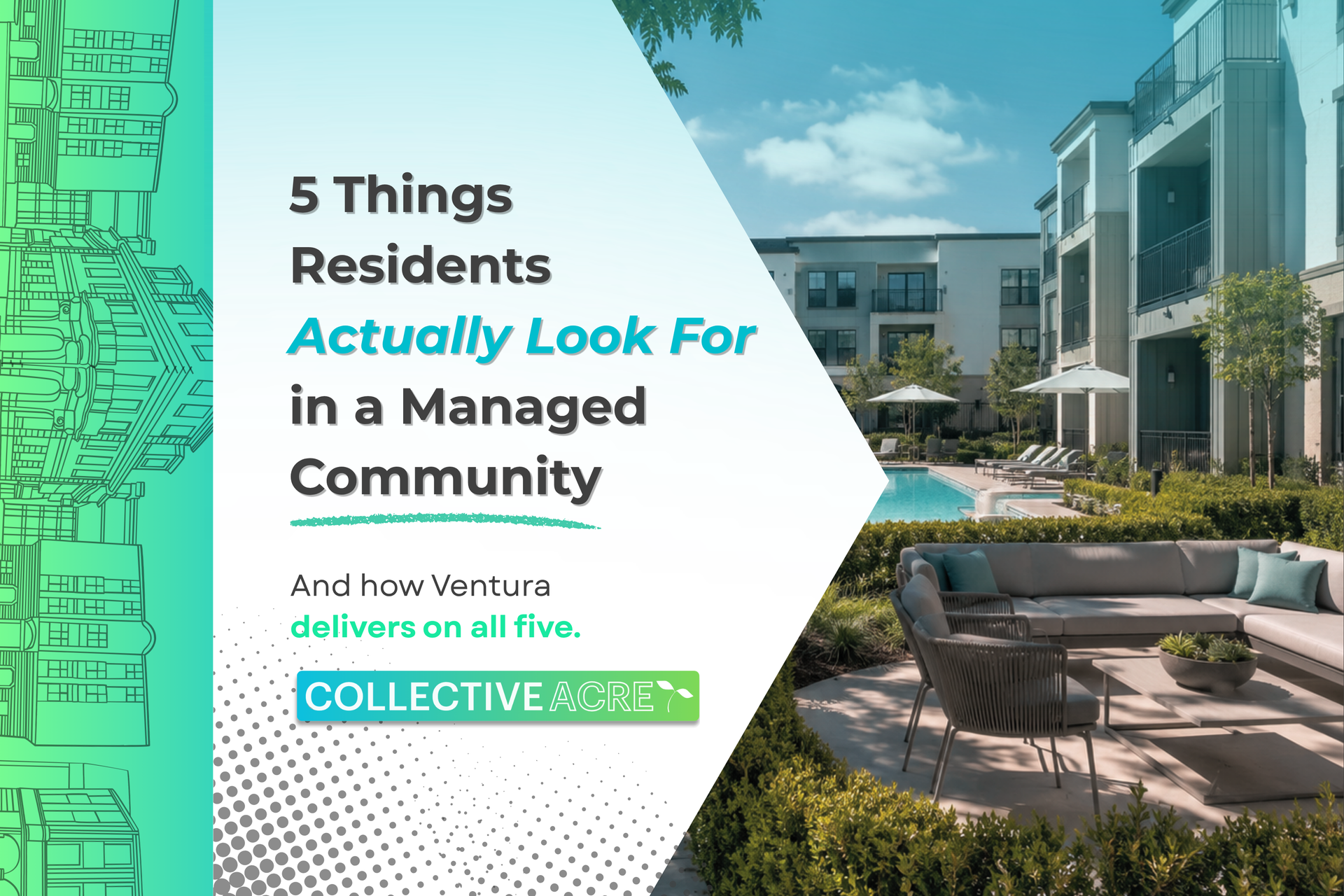
5 Things Residents Actually Look For in a Managed Community — And How Ventura Delivers on All of Them
There is a meaningful gap in the managed community market — and it is not a gap in amenities, square footage, or price. There is a gap between what operators assume residents want and what residents actually tell researchers they prioritize when choosing where to live and whether to stay.
The 2026 Resident Experience Management Report, produced by Zego in partnership with SA Market Insights through surveys of both renters and property managers, documents this gap in detail. Average retention rates have dropped to 57% in 2026, down from 60% in 2024 — precisely when operators can least afford it. The report attributes this decline not to amenities or pricing alone, but to a widening perception gap between what operators believe they are delivering and what residents actually experience day to day.
At Collective Acre, we built Ventura around a specific and deliberate answer to this gap. Before designing the community's operations, we looked at what the research actually tells us about the five things residents consistently prioritize in a managed community — and we built our management approach around closing those gaps rather than assuming they do not exist.
This article examines each of those five priorities and explains how Ventura's management philosophy addresses them directly.
1. Responsive Management — The #1 Priority Residents Name
The most consistent finding across resident satisfaction research is not about amenities, location, or price. It is about people.
A myQ Community survey, cited in the 2026 Multifamily Property Management Trends report published by parcelpending.com, identified overall friendliness when interacting with staff as the number one resident priority. Not the pool. Not the fitness center. Not the parking. The human interaction with the people who manage the community.
This finding is consistent with the broader body of resident satisfaction research. Residents who feel heard, respected, and responded to by management are significantly more likely to renew their lease, recommend the community to others, and tolerate the minor inconveniences that are inevitable in any shared living environment. Residents who feel ignored or dismissed by management will leave — and they will describe their experience publicly.
At Ventura, responsiveness is not a policy — it is the operating standard. Residents receive answers, not automated replies and not extended wait times. When a maintenance issue is reported, it is acknowledged promptly and resolved with transparency about the timeline. When a question is asked, it is answered by someone who knows the community and cares about the outcome.
In a market where average retention has fallen to 57%, responsiveness is not a soft skill. It is the most measurable driver of the outcome operators say they want most: residents who stay.
2. Maintained and Well-Kept Shared Spaces
Residents consistently rank community appearance and cleanliness among their top three priorities, alongside maintenance repairs and security, according to the 2026 Multifamily Property Management Trends report.
This priority operates on a specific psychological mechanism: the condition of shared spaces signals to residents how management views them. A well-maintained community communicates respect. A neglected one communicates indifference — and residents respond to that signal quickly, regardless of what the brochure says about the amenities.
The Community Associations Institute's research in the Texas market reinforces this dynamic. With more than 22,300 community associations statewide and over 6.1 million Texans living within them, Texas residents are experienced community association participants. They know the difference between a management team that maintains standards consistently and one that responds reactively when conditions deteriorate.
At Ventura, maintenance of shared spaces is not event-driven — it is systematic. Standards are set, tracked, and upheld whether or not anyone has complained. The reason is straightforward: by the time residents are complaining about the condition of a shared space, the damage to their perception of management has already been done. Consistent upkeep prevents that damage from occurring.
3. Safety and Security — A Non-Negotiable
Safety and security rank consistently among the top resident priorities in satisfaction research across asset types, geographies, and demographic profiles. The 2026 Resident Experience Management Report identifies security as a top-three priority alongside maintenance and community appearance.
For managed communities in particular — where residents share access points, amenities, and common areas with neighbors they may not know personally — the sense of security is not merely about crime prevention. It is about the confidence that the community is controlled, managed, and that someone is paying attention to who is on the property and what is happening within it.
This distinction matters operationally. A community that invests in controlled access, adequate lighting, and visible maintenance signals to residents that the operator is engaged. A community that allows these standards to lapse — even gradually — erodes the sense of safety that residents consider non-negotiable.
At Ventura, security is approached as a baseline standard, not a premium feature. Controlled access, consistent lighting, and active monitoring of community conditions are operational requirements — not optional upgrades. Residents should feel, from the moment they arrive, that the community is well-managed and that their safety has been considered in every design and operational decision.
4. Transparent and Proactive Communication
The 2026 Homeowner Satisfaction Survey, conducted by the Foundation for Community Association Research in partnership with Zogby Analytics across 3,000 nationally representative respondents, confirms growing resident support for community engagement and long-term planning transparency. Residents who understand what is happening in their community — what projects are underway, what fees are covering, what management is working on — report significantly higher satisfaction and belonging than those who feel uninformed.
The Zego 2026 Resident Experience Management Report adds important nuance to this finding: residents have strong preferences about the channel through which they receive communication. 49% prefer digital-only interaction for rent payments and 43% for tracking maintenance status — but 35% prefer human-only interaction for neighbor or noise complaints. Matching the communication channel to the type of interaction is itself a management skill that directly affects resident satisfaction.
At Ventura, communication is proactive rather than reactive. Residents are informed before they need to ask. Updates on maintenance timelines, community improvements, and operational changes are shared through the appropriate channels — digital for transactional matters, human for relational ones. The goal is to ensure that no resident ever feels surprised by something that management knew was coming.
In a community context, the absence of communication is itself a message. At Ventura, we choose to make that message an affirmative one.
5. A Genuine Sense of Community
The fifth priority is perhaps the most difficult to operationalize — and the most meaningful to residents who experience it. The 2026 Homeowner Satisfaction Survey's findings are direct on this point: positive neighbor relationships and participation in community activities are closely linked to stronger feelings of belonging, greater well-being, and overall satisfaction.
A managed community that provides excellent maintenance, responsive staff, and robust security but fails to create the conditions for genuine human connection has delivered infrastructure — not community. The distinction matters to residents. It is what separates a place to live from a place residents are proud to call home.
The research from the Community Associations Institute reinforces this: people in Texas communities want to feel proud of where they live and to build real connections with their neighbors. This aspiration is not passive — it requires an operator who treats the community as a social environment, not merely a physical one.
At Ventura, creating the conditions for genuine community is not a programming task — it is a management philosophy. It means maintaining spaces that invite residents to use them, fostering interactions between neighbors through the design and management of shared areas, and communicating in a way that makes residents feel they belong to something worth belonging to.
A community that achieves this does not need to compete aggressively on pricing to retain residents. Belonging is a more durable retention driver than any amenity upgrade.
The Management Thesis: Why This Matters for Investors
The five resident priorities examined in this article — responsive management, maintained spaces, security, transparent communication, and genuine community — are not marketing commitments. They are operational disciplines that, when executed consistently, produce measurable financial outcomes.
Lower turnover reduces vacancy costs, turnover expenses, and marketing spend. Higher satisfaction supports premium pricing relative to competing communities. Consistent maintenance preserves the asset value over time. A strong community reputation reduces the cost of resident acquisition. Together, these outcomes define what superior property management looks like from an investor's perspective — not as a line item, but as a return-generating factor.
At Collective Acre, Ventura represents our management thesis made concrete: a well-managed community in a high-demand DFW growth market is a better investment than an average-managed one. The research on what residents actually want confirms that the gap between the two is not mysterious — it is operational. And closing it is what we do.